

Buying fine jewellery online still requires a leap of faith.
Despite sleek websites and polished campaigns, the fundamentals often remain unchanged: customised pieces that take nearly two weeks to dispatch, unclear return policies, vague buyback terms, and quality claims that rely heavily on marketing language rather than measurable standards.
For a category built on trust and high-value transactions, that gap is becoming harder for modern consumers to ignore.
The Hidden Frictions in Fine Jewellery
Buying fine jewellery online still comes with quiet compromises. Customised pieces often take 10–14 working days to dispatch, return policies are restrictive or unclear, and buyback or exchange terms are frequently buried in fine print.
For consumers making high‑value, emotional purchases, this creates friction — not always visible upfront, but felt once the transaction begins.
It was this gap between modern branding and outdated fundamentals that led Vaama Jewellery to enter the category. Built as an online‑first brand, Vaama set out to address these frictions at an operational level rather than through marketing promises alone.
A Different Operating Mindset
Founded by Akshat Shah, Vaama Jewellery approaches fine jewellery with a simple question: what would the buying experience look like if customer risk, and not brand convenience, came first?
That thinking shows up early in the process. Customised pieces are dispatched within seven working days — significantly faster than the industry’s typical timelines — enabled by tighter production planning and smaller, controlled design drops.
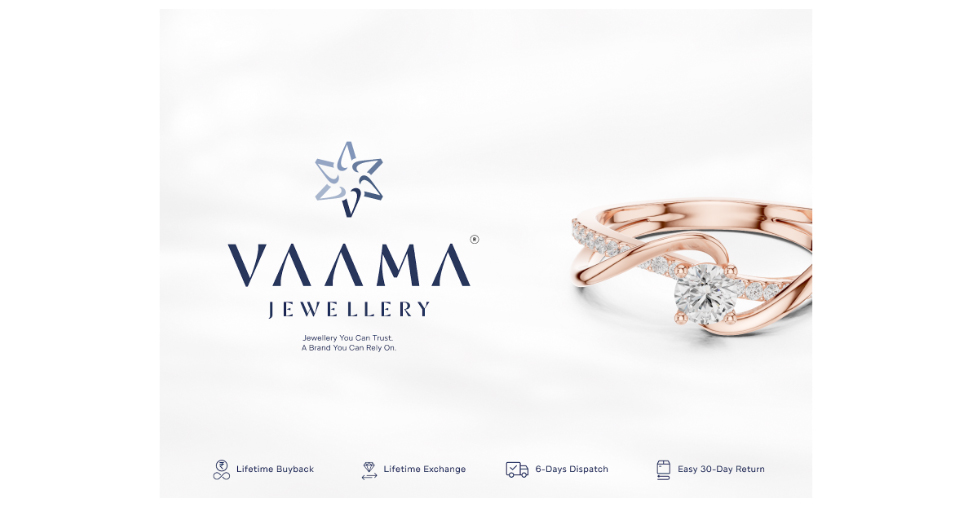
The same mindset extends to policies. Vaama offers a 30‑day return window, along with lifetime buyback and lifetime exchange options. Instead of positioning jewellery as a one‑time, irreversible purchase, the brand treats it as an evolving asset customers can revisit over time.
As Akshat explains:
“We didn’t want to build another brand that just sounds modern but operates like everyone else. The focus was on fixing basics — speed, accountability, and clarity — No other B.S”
Quality Beyond Certification
Where the brand takes an especially firm stance is in diamond selection.
For smaller diamonds, Vaama maintains EF colour and VVS clarity standards. For solitaires above one carat, the requirement moves to IGI-certified E colour, VVS2 clarity solitaires. More notably, the brand states that only two out of ten diamonds it evaluates meet its quality check, making each diamond shine bright and last forever.
This filtering often means rejecting stones that meet general industry benchmarks but fall short of internal thresholds. While such selectivity may limit volume, it reinforces a positioning built on consistency rather than compromise.
The company is BIS licensed and provides IGI certification for qualifying solitaires, grounding its claims in recognised standards rather than brand-defined terminology.
As the founder of Vaama Jewellery puts it:
“We’re not trying to out-market legacy brands — we’re trying to out-discipline them on speed, quality, and accountability.”
From Marketing Promises to Policy Proof
The broader shift within fine jewellery appears to be moving away from aspirational storytelling alone and toward structural reassurance — faster fulfilment, transparent quality benchmarks, and policies that reduce buyer hesitation.
As more consumers choose to purchase fine jewellery online, brand size may become less important than operational clarity. In that environment, trust will increasingly be defined not by advertising scale, but by dispatch timelines, return windows, and measurable quality standards.
For emerging players like Vaama Jewellery, the opportunity lies not in redefining luxury — but in making it feel accountable.